Icons of Europe This fleur-de-lys represents the aims of Icons of Europe asbl.  The fleur-de-lys figure has been used as an ornament or emblem by almost all civilisations of the old and new worlds.
Overview of Chopin research since 2003 Home | Feedback | Log-in
Fryderyk Chopin (1810-1849) in 1838.  Fragment of an unfinished painting by Eugène Delacroix.  Musée de Louvre, Paris.Icons of Europe has since 2003 researched
Chopin's life and mythological legacy with particular focus on his final years (1848-1849) and the posthumous period.

"The one duty we owe to history is to rewrite it"
Oscar Wilde (1854-1900) in The Artist as Critic.

.


New update in March 2008
Overturning longstanding assumptions and myths, the new research findings are well-documented.  In summary:

  1. Chopin had in 1848-1849 (after George Sand) a secret love affair with Jenny Lind, the soprano megastar and philanthropist known as The Swedish Nightingale.  They met in London in May 1848 at the start of her opera tour of England, Scotland and Ireland.  Wealthy, savvy and well-connected, Lind became quickly Chopin's financial and musical patron.
     
  2. With the knowledge of Queen Victoria, Jenny Lind travelled to Paris in May 1849 in a secret but unsuccessful attempt to marry Chopin in a city riveted by revolution and street fights and a deadly cholera epidemic.
     
  3. After Chopin's death and her own triumphal concert tour of America in 1850-1852 - during which she earned a huge amount of money and married her accompanying German pianist - Jenny Lind devoted the rest of her life to paying tribute to Chopin’s music and enshrining his legacy.
     
  4. Using the ancient symbols of Orpheus and St. Cecilia, Jenny Lind stimulated the development of a mythological framework in which Chopin’s music and their romance became sources of inspiration for composers, poets, painters and sculptors in La Belle Époque - e.g. Liszt, Stravinsky, Sullivan, Wagner and Wilde as well as exiled Polish artists.
     
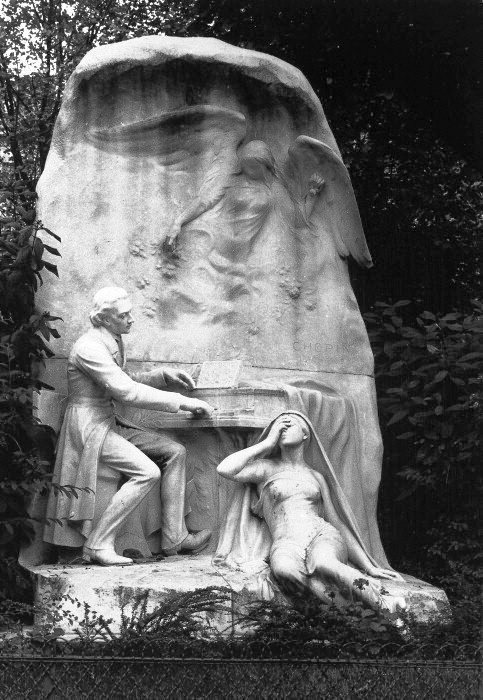
  5. All along, Jenny Lind made an elaborate cover-up of her true relationship with Chopin in complicity with their friends as well as patrons such as Queen Victoria and her family, and later the Tsar in St. Petersburg, members of The Saturday Club in Boston, and Princess Edmond de Polignac (Winnaretta), Paris.  These patrons also supported the creation of memorials for Chopin (e.g. at his birthplace, Parc Monceau in Paris, and Lazienki Park in Warsaw) and for Jenny Lind at Westminster Abbey.

Research reports on items 1 and 2 have been reviewed with experts in Warsaw, Edinburgh and Brussels.  A research report on items 3, 4 and 5 is being prepared.

MORE  >>  Comments by experts | Log-in | Contact us

Fryderyk Chopin (1810-1849).
Fryderyk Chopin
(1810-1849)
Jenny Lind (1820-1887)
The Swedish Nightingale
Queen Victoria
(1819-1901)


Icons of Europe's current research focuses in particular on the enshrinement of Chopin's legacy in the 1849-1929 period. 

It continues to be conducted in consultation with the Fryderyk Chopin Institute in Warsaw;  with national archives, libraries and museums of Britain, France, Poland and Sweden;  and with many other institutions. 


Research evidence presented in several reports and essays:

Copyright © 2003-2006 Icons of Europe, B-1380 Lasne.
All rights reserved.
Filed at the Copyright Office of the United States Library of Congress, Washington, DC and at copyright authorities in Brussels.


Produced by Icons of Europe based on the research:

New Chopin biography
-
 Musical drama and concert
"Chopin in the World" essay
-  Screenplay for a new film
Chopin 2010 proposal


1