Icons of Europe This fleur-de-lys represents the aims of Icons of Europe asbl.  The fleur-de-lys figure has been used as an ornament or emblem by almost all civilisations of the old and new worlds.
Chopin:  new research and tributes Home | About us | Contact
Updated April 2008
Icons of Europe's research in 2003-2007 unravelled Chopin's secret romance with Jenny Lind, The Swedish Nightingale.

Chopin had broken with George Sand in 1847.  To escape the hard times caused
by the French revolution of February 1848, he travelled to London in April ...
 

Watercolour of Chopin (1810-1849) by Kwiatkowski, 1849.
 
Fryderyk Chopin
Zelazowa Wola 1810 - Paris 1849
Watercolour by Teofil Kwiatkowski

« Chopin met Jenny Lind in London in April 1848.  The wealthy and well-connected soprano became quickly his musical and financial benefactor.  With Queen Victoria in the know, she travelled to Paris in May 1849 in an attempt to marry the ailing Chopin.  However, the cholera forced her to flee.  She returned in October just before he died and organized his grandiose funeral at La Madeleine. - While covering up her romance with Chopin, Jenny Lind devoted the rest of her life to enshrining his legacy.  The Orpheus legend provided a theme for paying tribute to Chopin's music. »
 
Queen Victoria
(1819-1901)

DOCUMENTATION OF THE FINDINGS (back)

Icons of Europe has documented its main research findings on
Chopin and Jenny Lind's relationship in two major publications:

  1. The biography Chopin and The Swedish Nightingale by Cecilia and Jens Jorgensen, Brussels 2003, ISBN 2-9600385-0-9.
    Poland's Ministry of Culture consulted on a draft in Warsaw on 14 May 2003.
     
  2. Research paper of 1 March 2004, revised 29 January 2005.
    The comprehensive original period evidence, some not seen before, was provided by national archives, press libraries, and other sources in Europe. Research paper made available to the Fryderyk Chopin Institute and others.

... and produced supporting essays and analyses:

.... as well as information and events on related subjects:


EXPERT OPINIONS, THE MEDIA (back)

Chopin experts have commented favourably on the new research:

The media have reported on the new research findings:
Wiener Chopin-Blätter (Vienna, Autumn 2003);  Berlingske Tidende (Copenhagen, 21 November 2003);  Chopin in the World (Warsaw, 2003-2004 and 2004-2005);  Polityka (Warsaw, 6 March 2004);  Musica Nova (Tokyo, 6 Sept. 2004);  and other media.


CHOPIN AND THE NIGHTINGALE (back)

Chopin and The Nightingale
is a dramatic reading with music in six acts for narrator,
two sopranos and piano (about 75 minutes).
Music by Bellini, Chopin and Meyerbeer
as well as two Scandinavian signature-songs.

The drama re-enacts the newly-discovered romance of the ailing Chopin and the celebrated Jenny Lind, The Swedish Nightingale, in 1848-1849.  Quotes from Chopin's letters and Hans Christian Andersen's The Nightingale set the stage for each act of the drama.  Andersen wrote the story in 1843 as a tribute to Jenny Lind.  In act VI, she sings Chopin's Mazurka in A-flat Op. 24 n° 3 for Queen Victoria ... and "the emperor says Good morning!"
Poster 2005 | Jenny Lind at Chopin's deathbed (video of act V)** | Other songs

Jenny Lind sang her own arrangement of Recueil de Mazourkas de F. Chopin  for Queen Victoria at Windsor Castle in 1855, and at Buckingham Palace on 30 May 1856 with Pauline Viardot ("... faithful love will never die").  It is enacted in acts IV and VI of Chopin and The Nightingale.  The original scores are available as well as an arrangement of Bellini's Casta Diva for piano, which Jenny Lind sang at a TB charity concert at Her Majesty's Theatre on 31 July 1848.  Was it Chopin's version***?

Chopin and The Nightingale has been staged at Brussels, Warsaw and Toronto
in 2003-2005 to celebrate the new Europe and longstanding transatlantic relations.  The U.S. premiere is set for July 2008 in New York State to mark World TB Day.
Cecilia and Jens Jorgensen (Icons of Europe) are the playwrights and hold all rights.


CHOPIN INITIATIVES IN THE PIPELINE (back)

Leading up to Chopin's 200-year anniversary in 2010 and beyond:

  1. U.S. premiere of Chopin and The Nightingale, July 2008
  2. Comprehensive essay in a well-known global magazine
    on the Chopin / Jenny Lind research 2003-2008.
  3. New premiere of Chopin and The Nightingale, Europe 2009.¹
  4. TV film of Chopin and The Nightingale premiere for global use.
  5. Possible use of existing draft film script (discussion with Endemol).
  6. Continued research of Chopin commemorations and a book. 
    Jenny Lind masterminded a Chopin scheme.  It inspired patrons and artists (Orphism², Warsaw³, Paris salons, de Polignac, Paderewski, Rubinsteinª, Louvre, Boston Club, ZW park 1894, Oscar Wilde, La Belle Époque).
¹ Under consideration by the City of Lodz. - Icons
of Europe has suggested the European Capital
of Culture 2016 bid could be strengthened by:


Copyright © 2007 Icons of Europe B-1380 Lasne.


Jenny Lind (1820-1887)

The celebrated soprano and wealthy philanthropist Jenny Lind, The Swedish Nightingale, was adored by Queen Victoria and other monarchs in Europe.  Hans Christian Andersen wrote The Nightingale (1843) as a tribute to her.

Jenny Lind was court singer to the King of Sweden and Norway (Jean-Baptiste Bernadotte), the Emperor of Austria and the King of Prussia.

She had therefore access to Emperor Nicholas I of Russia (ruled Poland 1825-55) and to Louis-Napoleon Bonaparte who became president of the French Republic in December 1848.


Swedish banknote since 1996


Icons of Europe


Activity since 2002


Chopin initiatives


"The seamlessness ..."

Ljiljana Jovanovic performing the final aria of Bellini's opera "La Sonnambula" in Act 5, Death of Icons of Europe's musical drama at the Swedish Embassy, Warsaw on 6 April 2004.  The act portrays Chopin's final hours shortly before 17 October 1849.

H.E. Mr Charles Crawford, Ambassador of the United Kingdom wrote to his government about the Warsaw premiere of Chopin and The Nightingale at the Embassy of Sweden on 6 April 2004:

"It ingeniously brought together historical and musical elements from all over Europe ... to bring out the seamlessness of great European culture."


Orpheus


"The nightingale sang
over the grave of Orpheus"

at
Place Vendôme
La Madeleine
Père-Lachaise
American tour 1850-1852
Windsor Castle 1855
Buckingham Palace 1856
Concerts in Poland 1858
Théâtre Lyrique, Paris 1859
Paris salons of La Belle Époque

Commemorative venues
Westminster Abbey 1894


*JENNY LIND AT CHOPIN'S FUNERAL
Jenny Lind's Memoir of 1893 shows that she had no alibi for most of October 1849.  Unlike Chopin's local friends, she could have afforded to fund the lavish funeral and she had the clout to seek government permission for this unprecedented event.  She knew well Lablache, Viardot and the alleged "Mme Castellan" from London in 1847 and 1848. 

However, the German viola player Fr. Niecks (II, p. 325) is the only source mentioning Castellan, and he cites Jenny Lind as one his few surviving "chief sources of information" (she appears even to have commissioned and edited the book).  Castellan was known as a second-rate singer, who very unlikely could have been entrusted the key soprano part of Mozart's Tuba Mirum at the funeral of Jenny Lind's beloved Chopin (ref. existing and new information posted at Wikipedia by Icons of Europe). - This highly emotional event could be re-enacted in 2010.

** ACT V:  Jenny Lind performs "Ah non credea" (Amina), the Finale of the last act of Bellini's opera La Sonnambula at Chopin's deathbed.  The original score says, "... as sung by Mademoiselle Lind on the Stage and subsequently at her Concerts".  Benjamin Lumley, director of Her Majesty's Theatre in 1847-1849, writes in 1864:  "Whilst Jenny Lind was in Paris [in 1849] ... she sat down to the piano and gave her incomparable Non Credea Mirarti."

*** CASTA DIVA:  "Rekonstrukcija akompaniamentu F. Chopin do cavitiny "Casta Diva" i arii di bravura "Ah, bello a me riterna" z opery Norma V. Belliniego" [sic].

Back to top


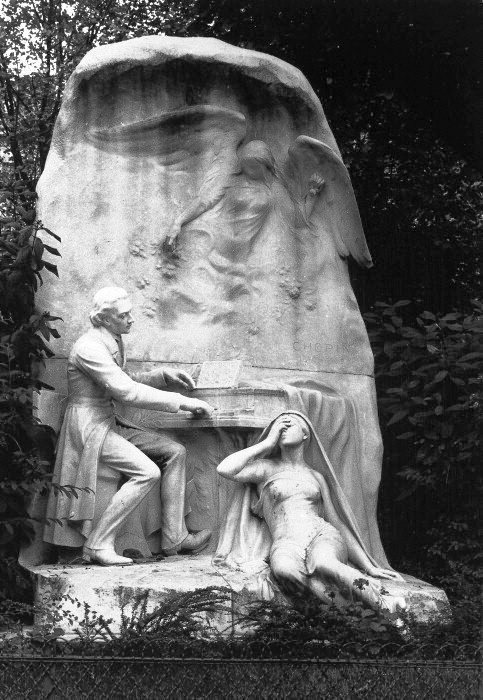
Chopin under an uprooted tree
as in the Orpheus legend


Medal by Szymanowski
1926, Niggl n° 506

² ORPHISM could be defined as the creative expression of Greek mythology with the Orpheus legend at its centre.  This legend originated in the sixth century BC.  It has through the ages and till today exerted a considerable influence on Western culture.
Orphism in Chopin artworks
Roots of the Symbolist movement


³ CHOPIN / ORPHEUS AT ŁAZIENKI PARK, WARSAW
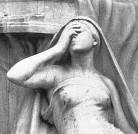
Wacław Szymanowski's massive sculpture at Royal Łazienki Park in Warsaw (photo left), cast in Paris around 1902, seems to portray Chopin / Orpheus under a 'tree uprooted by the power of his music'.  Szymanowski studied in Paris in 1875-1880 under Cyprian Godebski, who “specialized in bronze busts of celebrities … and allegorical statuettes”.
Ovid writes:

"And list'ning trees their rooted stations leave;
Themselves transplanting, all around they grow,
And various shades their various kinds bestow.
Here, tall Chaonian oaks their branches spread,
While weeping poplars there erect their head."

Source:  Metamorphoses, Book X, The Story of Orpheus and Eurydice by the Roman poet Ovid (born 43 BC). - Icons of Europe conveyed in 2006 and 2008 this observation to the National Museum in Warsaw and the Fryderyk Chopin Institute.

ª ARTHUR RUBINSTEIN
Icons of Europe's research links Arthur Rubinstein with Princess Winnaretta de Polignac (his patron in Paris), whose salon was known as a "Temple of Orpheus".  With a special connection to Jenny Lind (1820-1887), Winnaretta (1865-1943) played a key role for many years in promoting CHOPIN's music with the apparent objective of emphasizing his Polish origin.

Arthur Rubinstein "received international acclaim for his performances of Frédéric Chopin and Johannes Brahms (1833-1897) and his championing of Spanish music".  Important Spanish composers are Isaac Albéniz (1860-1909) and Enrique Granados (1867-1916). - NB:  Granados' 100 year-anniversary in 2016 coincides with Córdoba's bid for becoming European Capital of Culture.